I’m working on a new video for this. It’s a poor lesson because it doesn’t explain the WHY. First of all, nominal standards have been with us since the civil war and balloon framing boom. This was directly influenced by two things: the railroad and the green bar on the architect’s scale. The nominal dimensions of stick framing lumber are chosen to fit checksums within the 3/4 per inch scale.. even when boards were planed 7/8 or 1” that is still in the scale. All of this in the effort to use wood to compose cornice and stone building forms. Nicholson and some other “revivalist” 18th century treatises wrote whole books in the practice of specifying nominal dimensions from the desk which would translate to “shrunken” classical orders appropriate for wood.
That explains the shape… and size.
As for the quality and performance.. thats a whole book…. I would read “American canopy” if I were me. that’s all based on how the tree grew. And how it was chosen to be sawed. Plantations and monoculture logging produces poor timber products. The trees should mostly be left alone. Managed for biodiversity and maturity and harvested ethically for permanent building intents only.
Some notes on the actual forensics of each section. The 1920s tree is a young tree super fast growing, so it likely grew from clearcut. It would never be a good beam. It has a use at this age: They chose it for this purpose to be a stud, or vertical member of a superficial wall.
The 60s section is a slow growing tree, with a lot of integrity so likely logged from the west or north. But it was methodically production cut into a modular unit with no regard to grain direction or function. It could have been as well, beams or bearing planks, but was sold as a superficial stud.
The modern commodity lumber is made that way to “make line go up on a balance sheet.” It never should have been harvested.
How to judge a tree with human power for permanent building.
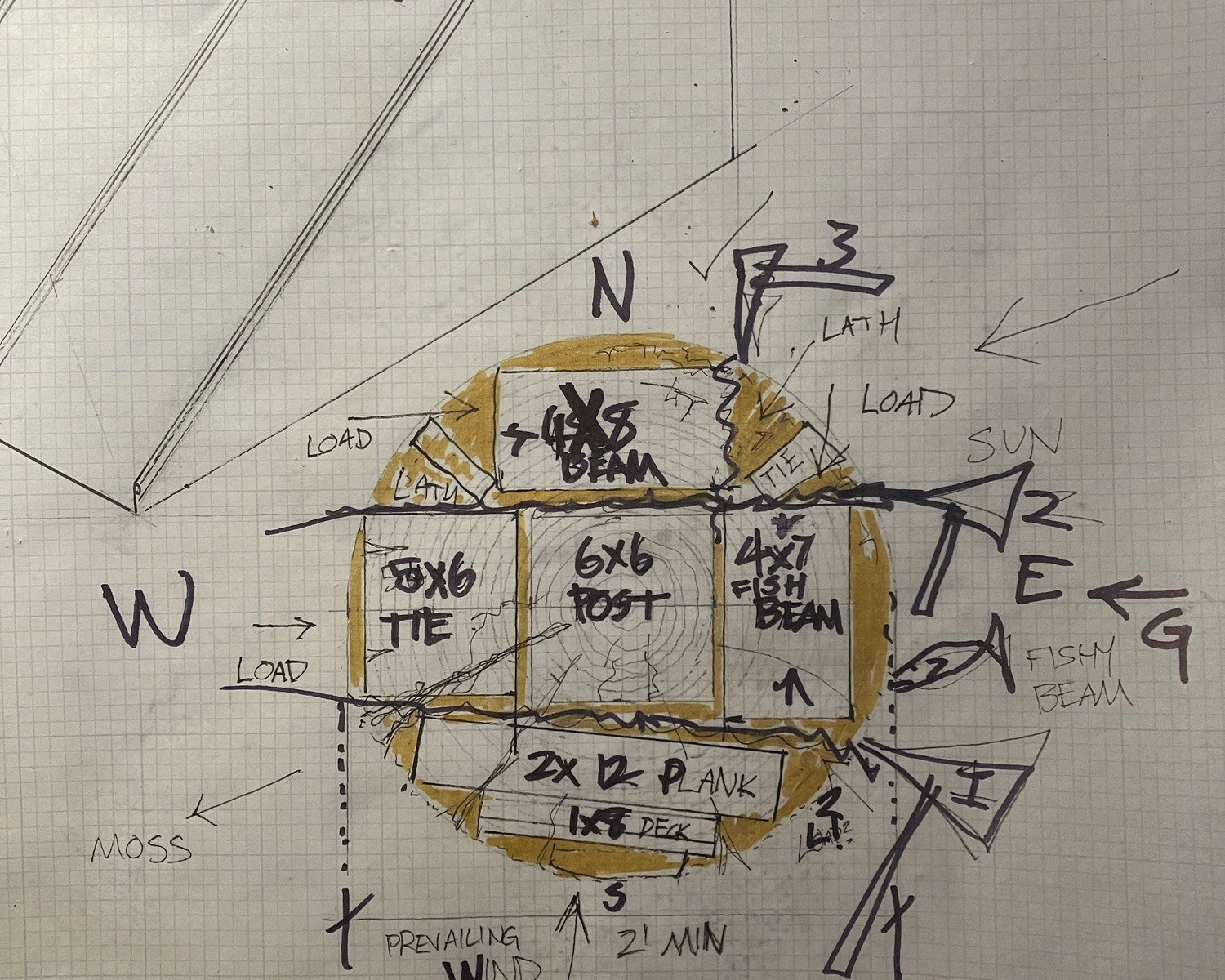
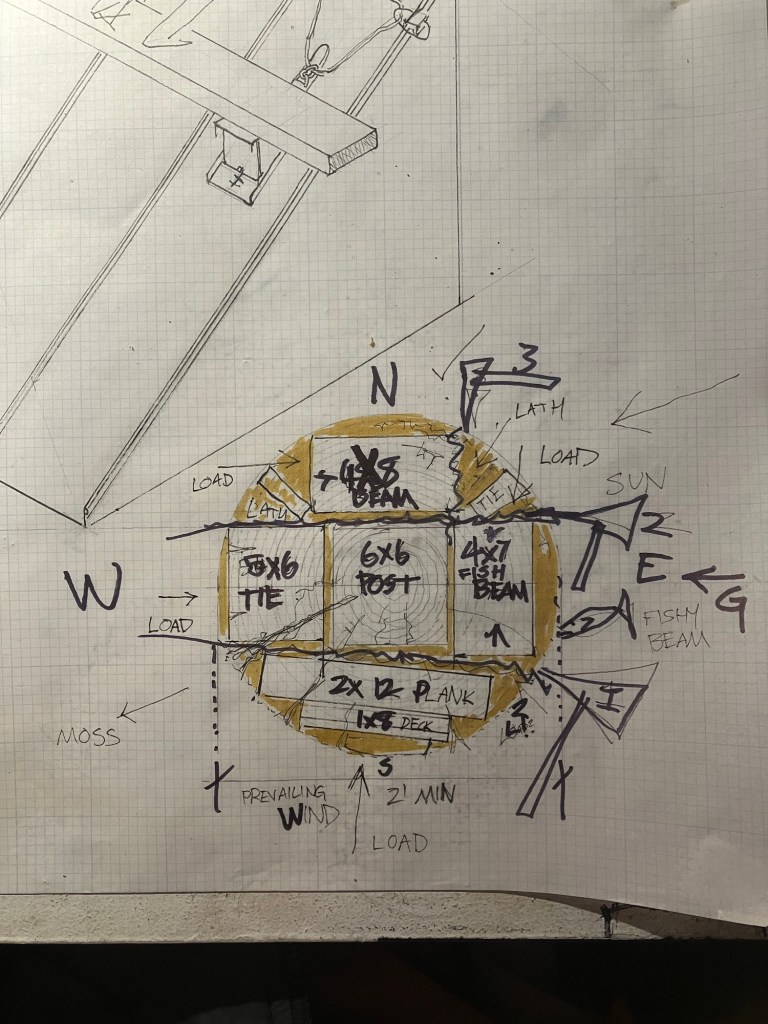
Wood from trees is judged accordingly: first you find a tree at least 2’ in diameter.. you look for the prevailing wind and spring line. You mark the tree on that axis and injure it to the sapwood. You come back the next season to Harvest it. Simple as.
How to grade cross sections for building units:
Beams: beams come from the spring line they have grain running parallel to the load. And they are growing towards the sun and crowned by the wind loads.
Post: post are the heartwood, they have compressive strength
Ties: ties are from the quarters. They have grain running at skews to the face. Great for cross joinery and tension.
Planks: planks are the strong back of the tree, the section which bent and stretched the most. Perpendicular to spring line with grain running in an arc across the load center.
Heavy machinery has always been not required. We inherit these legacies from Victorian era industrial engineering.
Woodworking tools are a great example. The benchmark of a “quality” production woodshop have always been planing, and profile shaping. A good shop produces quality with heavy iron backstops and machining. And man hours. Raw power in the axis and feed and heavy mass to resist the “assumed” forces
And to do these at scale and keep the humans safe according to the millwright union you gotta have a lot of industrial infrastructure…. Vacuums system, heavy floor, electrical services, safety and ergonomics.. etc. all these things installed and planned for just to give the millwright a job and keep the crown molding or fancy flooring coming off the line. All of this centered around a high speed axis and small special tooling that the wood is fed into, creating sawdust and noise. All this precision machining and heavy plates intended to produce repeatable quality….
The whole system need not exist.
Consider the trad version of both these activities, hand plane and molding plane. And the downforce that a human body walking can produce…. To drive the plane. You need only two fingers worth of force back n forth, and 120lbs on a feather spring of downforce
Now consider a solid table with clamping and a lightweight track frame system that attaches to the table. You load the board. You load your appropriate plane. You activate the motion control and very low power drill motors run the plane back n forth to save the labor of the millwright and cut or plane the piece. You get the same precision and quality and ease of operation…. You have clean shavings with no dust as your waste product. No noise. No infrastructure needed other than a solid table 16’ long, and frame to hold the motion control. All infrastructure (the table and frame) could be hand assembled by one person on site and packed in the back of a truck in 8’ sections.
The same process goes for sheet metal fabrication: there is no need for a heavy floor break. You need a roller dolly, 10’ track system and back n forth motion control. Combined with profile-specific roller dies that mount to the trolley.
Automate this instead of building 4 ton factory equipment and robotics.
The same can be said for heavy offroad cranes and lifts. For a residential building you can erect a stage/tent truss first, which can handle all lifting and placing with low power electric motors and motion control. We never needed a lull or man lift industry.
who “owns” the history of building? is it mathematician/engineers and royal society professionals from the 19th century? do scholars and academics have a claim to the history of building culture?
The professional institutions have been with us less than 200 years. Before their introduction the culture and history of building was mostly by laborers, for laborers.
Most architects and philosophers want to start this prompt, by asking: where does medieval architecture “come from”?. I have a wild proposal, you made up the whole framework. In the material world: There is no such thing as architecture. There are building methods, materials, and the descriptive geometry used to create forms or intersect surfaces. And the human effort involved.
“Architecture” is the application of ideology about building, after the fact usually by those not involved in the practice of labor. Put another way: Architecture is fashion. ”Building culture” is garment construction.
To that end the specifier and speculative classes fail themselves, and they have failed their brother humans as an institution and practice. Left unchecked, they will continue to make busy work for their class: inventing another debate on the origins of form that reminds us of the bozos looking for dark matter.
Where is the practice? Arguing over fashion and teaching people to think it’s ok to behave this way…. Digging in even harder in historicism on the other end of the pool. The practice is lost as it ever was.
I want to scream.
We start our timeline the location of modern Prague: 500 bc. Celtic boii scribing floor showing the development of a cone. They have mass walls and timber frame roofs., a fully developed recognizable cannon of human scale home “architecture”, similar to china and the levant. many cultures did it. Nobody did it like the boiis. The speculative “masons” on wet island will come to fetishize this building culture but improperly attribute their achievements and origins to Greek and Egyptian traditions, even though writers of the time differentiate them as “not Sicilians, not Greek”. They are “othered” by the writers of their time. They are noted to build villages and fortifications, by Cesar himself.
Where “architecture” comes from? the myth of the dark ages started in the 19th century to sell “class” and “art”.
The supposed “dark ages” 700 years of brick and stone, hot mixed mortars, timber joinery.
It’s called the dark ages because they could only get brown filters for the video cameras back then, and a bunch of 19th century weirdos in an institution said so.
Forms of all imaginable construction both regional and imperial. All mass wall or timber frame, all based on this continental corpus of structural integrity, in pursuit of interior comfort. The “architects” from enlightenment and victorian eras focus on the churches and high examples of cultural expression. All of them are exploiting similar geometric tricks to generate impressive forms. This is where the field has been lost for 200 years, myth making and hyper-analyzing the “origins” of something that is simply a rule of triangles or circles, exploited well by craft laborers .
But what about the regular folk on the continent? Most of the population didn’t live in cathedrals or think of their buildings and labor in the same way a 19th century intellectual would. The humans who lived within these structures have cherished words for comfort and warmth. In the indo-european root Buh: It means “we’re sick of living in caves and real happy these folks showed up”. They value textiles, and human effort to create comfort. Their homes were warm and dry. They have many words to describe the creators of comfortable places, Maestro is the Latin root. Techton in Greek. The people of ancient times described the laborers who provided comfort and warmth, from their own culture and language as “masters” and “builders”.
There was nothing dark about this time, if the people are to believed by their own words. They were obsessed with being roman, no matter where they were, and so they would favor classical sources in their “library” and throw out their own periodicals and contemporary works often. We see this bias running all the way thru the cultural curation right up to the reformation.
Roman’s who? They used the building cultures of their enslaved people: impressive only for scale and administration. We had concrete of the same chemistry in turkey and china. The forms are all stolen from Greeks jacking it about how you can make big stone blocks look like a boob if you squint real hard and the sun is just right.
Aachen 800ad: (the stadium glam rock era for crafts and building history): founding of coppersmiths for tailoring and joinery and glass making “studies”. With the patronage of Chalamange, crafts in building arts become established institutions within the monasteries. The palace at Aachen becomes the “Jay Lenos garage” of medieval Europe.
Aww Charles.. bless his little king Heart. he just loved him some workers and sciences and all the cool things they made. He would have been a Joe Rogan style guy today. Kinda dumb, loyal like an inbred dog, surrounding himself with cool wizards and “smart guys”. You do, unfortunately kinda have to hand it to “him” for the patronage to the building arts.
16th century: Del’orme: Europe’s father of master builders. A retired stone cutter in his sundown years produces the first books of architecture for the modern world. His declarations Made builders, architects, and mathematicians mad for 400 years. Shout out to a master poster and troll. Taught us how to make a stone ceiling look like a smashed trumpet, with circles and witty math.
16th-17th century Compangnon is made French military secret; the march of imperial power shakes the world. On wet island: laws are passed to stop unions of laborers forming. Machine breakers fight back. Police invented to stop laborers revolts.
Quick rewind to the 15th century to look at the dome in Florence. The guy Brunelesci was a master, but not because of “the Renaissance”. It is claimed he “went to Rome” to study the masters of antiquity. What he actually did was humble himself to seasoned military carpenters, and his laborers. He stood on the scaffold with them for each new step of the dome. He produced all the stereotomy. Like Toyota and Paul Akers: Bruno designed the work around the worker, he put himself in their shoes for every step. This is why the dome was completed in his lifetime. It must have been. He came to the junket with science, power and glory.
All the renaissance is stolen valor of his master achievements bringing real worldly culture to Italians. Please feel free to bully these weird pasta hicks, they couldn’t even invent a tomato. The juicy, red food they are known for arrives from the new world later this century: to much rejoicing by spaghetti chefs.
1660: wet guys: English merchants and striver class wigs establish mystery guilds in the model of Compagnon, because they are mad jealous of how cool and free master builders are. They will come to own pickleball courts and hamburger restaurants in America. Real uncut Calvinist shit.
18th century: professional class and civil engineering established. American revolution: timber rights. French Revolution: Compagnon made illegal along with other labor guilds. The birth of the corporation, the specifier as a class.
19th century: newly minted professional class dismantles craft practices, invents myths about history, fully establishes its authority to speak on building and labor. Industrial practice and unchecked extraction capitalism keep the economy line “proofs” coming up green.
At the end of the 19th century everything is crashing. All the prophets are made liars, the lofty dreams of the charismatics and lumpen alike cut up for tenements. Paper for balance sheets and newspapers ordered on speculation for the next year. The world feels the grip of apocalypse in all cultures, then oil is plumbed.
20th century. Dark ages. We don’t know what happened can someone with a degree tell us? Did yall see that? Did you see what they did there?
Let’s reiterate what this jumbled drawing proves…. In order to lay out the curve for a groin vault, you only needed to know the surface development of its inverse, the dome vault in square, and produce that net in the scribing floor. All cuts derived from tangents of that net line. This has been unfolded but I could have done it all within the original crossing section. There is no radius “off the sheet” required to produce the curve.
The knowledge needed to cut up a circle and project rafter lengths is building culture. it was known to all building cultures. The knowledge to refine clay and burn limestone, also a human building culture technology. Not roman. Never Lost. There are no mysteries or elusive building “dark arts”. Just service to duty and a lot of hard work.









 Trad Building
You must be logged in to post a comment.